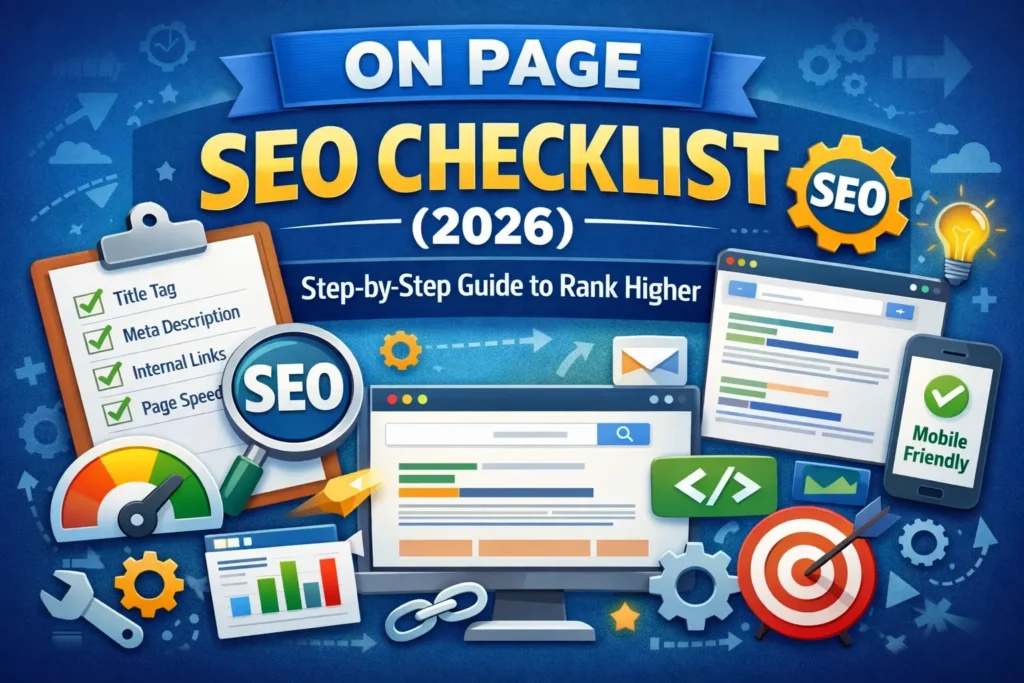
If you want your website to rank on Google in 2026, you need a strong on page SEO checklist.
Search engines have become smarter. Google now understands content context, user intent, and page experience better than ever. That means simply stuffing keywords won’t work anymore. You need proper optimization from title tags to internal linking.
In this complete guide, you’ll learn a practical and updated on page SEO checklist that you can apply immediately to improve rankings and traffic.
What is On Page SEO?
On page SEO refers to all optimization techniques you apply directly on your website pages to improve their visibility in search engines.
It includes:
- Title tags
- Meta descriptions
- Headings (H1, H2, H3)
- URL structure
- Internal links
- Image optimization
- Content quality
- Page speed
- Mobile friendliness
Unlike off-page SEO (backlinks), on page SEO is fully in your control.
Complete On Page SEO Checklist (Step-by-Step)
Let’s break it down into actionable steps.
1. Start with Proper Keyword Research
Before writing content, choose the right keyword.
- Focus on search intent
- Check keyword difficulty
- Target long-tail keywords
- Analyze top-ranking competitors
For example, instead of targeting “SEO”, choose “on page SEO checklist for beginners”.
2. Optimize Your Title Tag (Most Important)
Your title tag is the first thing users see on Google.
Best practices:
- Include your primary keyword
- Keep it under 60 characters
- Make it clickable and benefit-driven
- Add year (2026) if relevant
Example:
On Page SEO Checklist (2026) – Step-by-Step Guide to Rank #1
3. Write an Engaging Meta Description
Meta descriptions don’t directly impact rankings, but they improve CTR.
Tips:
- Include primary keyword
- Keep it under 155 characters
- Add clear benefit or call to action
Example:
Follow this updated on page SEO checklist to boost rankings and drive more organic traffic in 2026.
4. Use Proper Heading Structure (H1, H2, H3)
Search engines use headings to understand your content structure.
- Only one H1 (main title)
- Use H2 for main sections
- Use H3 for sub-points
- Add keywords naturally
Good structure improves readability and SEO.
5. Optimize URL Structure
A clean URL helps both users and search engines.
Good example:yourwebsite.com/on-page-seo-checklist
Avoid:yourwebsite.com/blog?id=1234&cat=seo
Best practices:
- Short
- Include keyword
- Use hyphens
- Avoid special characters
6. Write High-Quality, Helpful Content
Google ranks helpful content.
Your content should:
- Solve user problems
- Be original
- Cover topic in depth
- Use simple language
- Add examples and steps
In 2026, content quality matters more than keyword density.
7. Optimize Keyword Placement
Don’t overstuff keywords. Place them naturally in:
- Title tag
- First 100 words
- At least one H2
- URL
- Image alt text
- Conclusion
Maintain natural flow.
8. Internal Linking Strategy
Internal links help Google understand your site structure.
Best practices:
- Link to related blog posts
- Use descriptive anchor text
- Avoid “click here”
- Link to high-priority pages
For example, if you run Soocel.com, you can link:
- SEO tools guide
- Keyword research article
- Blogging tutorials
This builds topical authority.
9. Optimize Images Properly
Images improve user experience but can slow your website.
Checklist:
- Compress images
- Use descriptive file names
- Add alt text with keywords
- Use modern formats (WebP)
Example alt text:
“on page SEO checklist example”
10. Improve Page Speed
Page speed is a ranking factor.
Improve by:
- Compressing images
- Enabling caching
- Using fast hosting
- Minimizing CSS and JS
- Using CDN
Aim for:
- Mobile score above 85
- Load time under 3 seconds
11. Make Your Website Mobile-Friendly
Most users browse from mobile devices.
Ensure:
- Responsive design
- Readable fonts
- Proper spacing
- Fast loading
Google uses mobile-first indexing, so this is critical.
12. Add Schema Markup
Schema helps Google understand your content better.
You can add:
- FAQ schema
- Article schema
- Breadcrumb schema
This increases chances of rich results.
13. Optimize for User Experience (UX)
Google tracks user behavior signals like:
- Bounce rate
- Time on page
- Click-through rate
Improve UX by:
- Short paragraphs
- Bullet points
- Clear formatting
- Engaging introduction
- Actionable steps
14. Use External Links (Authority Boost)
Link to relevant high-authority sources when needed.
This:
- Builds credibility
- Improves trust signals
- Enhances content value
But don’t overdo it.
15. Update Old Content Regularly
Content freshness matters.
Update:
- Statistics
- Year (2026)
- Examples
- Broken links
This keeps rankings stable.
Bonus: Quick On Page SEO Checklist Summary
Before publishing any article, check:
- Keyword in title
- Keyword in first paragraph
- Proper heading structure
- Optimized URL
- Internal links added
- Images compressed + alt text
- Mobile-friendly
- Fast loading
- Meta description added
- Schema markup added
If all are done — you’re ready to publish.
Final Thoughts
On page SEO is the foundation of ranking success. Even with strong backlinks, poorly optimized pages won’t perform well.
If you consistently follow this on page SEO checklist for every blog post, your website will gradually build authority, improve rankings, and increase organic traffic.
SEO is not about tricks anymore — it’s about structure, relevance, and user satisfaction.
Start optimizing today.
FAQs – On Page SEO Checklist
1. What is the most important factor in on page SEO?
The most important factor is high-quality, relevant content that satisfies user intent, combined with optimized title tags and proper keyword placement.
2. How many times should I use my keyword?
There is no fixed number. Use your keyword naturally throughout the content without overstuffing. Focus on readability.
3. Is on page SEO enough to rank on Google?
On page SEO is essential but not always enough. You also need off-page SEO (backlinks) and technical SEO for competitive keywords.
4. How often should I update my on page SEO?
Review and update content every 6–12 months or when rankings drop.
5. Does meta description affect rankings?
Meta descriptions do not directly affect rankings but improve click-through rates, which can indirectly impact performance.